
Wednesday 16 September 2026 13:09
Kandinsky at Palazzo Bonaparte: Rome’s Big Autumn Exhibition
Kandinsky returns to Rome after 25 years: 70 works from the Centre Pompidou, five sections and an immersive room. Dates, hours and tickets.
The post
Kandinsky at Palazzo Bonaparte: Rome’s Big Autumn Exhibition
appeared first on Romeing
.
#events in rome #rome exhibitions
read the news on Romeing
From September 15, 2026 to February 14, 2027, Rome’s Palazzo Bonaparte hosts one of the year’s most significant cultural exhibitions dedicated to Vassily Kandinsky, the father of abstract art. Produced and organized by Arthemisia in collaboration with Paris’s Centre Pompidou and curated by Angela Lampe, the exhibition brings over 70 iconic works to Rome for his first major retrospective in the city in over 25 years. With the Centre Pompidou preparing for a temporary closure for restoration, Rome offers visitors a rare chance to view masterpieces that rarely leave Paris.
BUY TICKETS
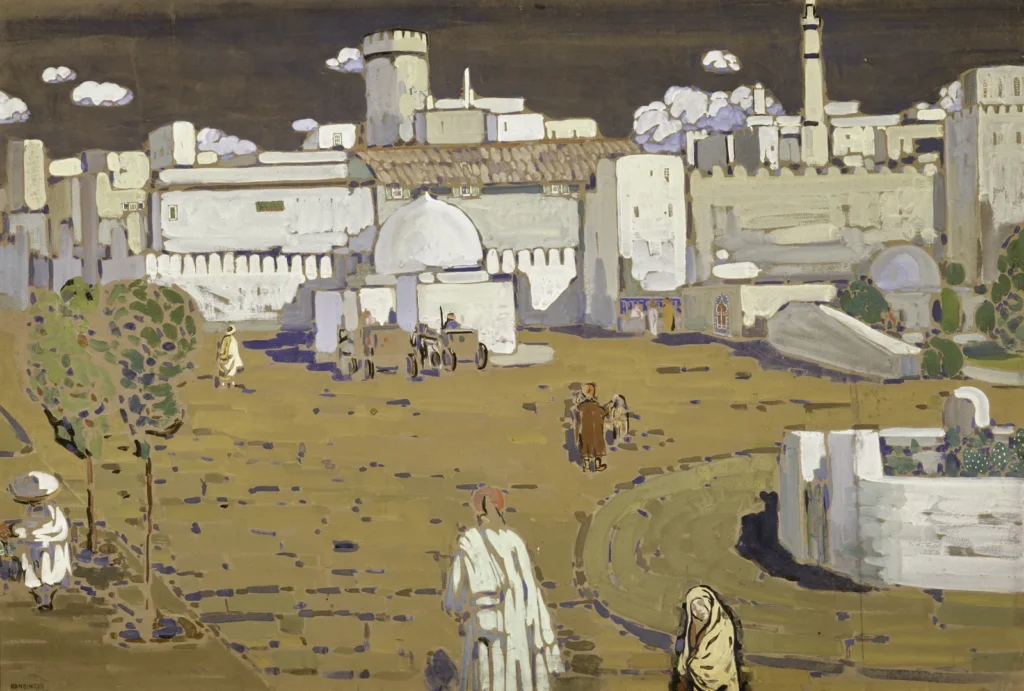
Vassily Kandinsky
Arabische Stadt (Ville arabe)
1905
Tempera sur carton, 67,3×99,5 cm
Legs de Nina Kandinsky, 1981
Collection Centre Pompidou.
Domaine public. Photo © Centre Pompidou, MNAM-CCI/Hélène Mauri/Dist. GrandPalaisRmn
Divided into five sections across two floors, the exhibition traces Kandinsky’s complete human and artistic transformation through different political climates, theoretical breakthroughs, and personal relationships.
The first section covers his formative years from 1866 to 1907. Born in Moscow, Kandinsky was not originally on a path toward art. He pursued a career in law and political economics at the University of Moscow before making the radical decision at age 30 to abandon academia and move to Munich to study painting.
This section reveals how two decisive experiences were the reason for this shift: seeing Claude Monet’s Haystacks, where he realized colors could evoke emotion without representing tangible objects, and hearing Richard Wagner’s Lohengrin at the Bolshoi Theatre, suggested that painting could function like music. On display here are early paintings like Old Town II (1902) and Schwabing, Winter Sun (1901), alongside folklore-inspired pieces such as Song (Song of the Volga) (1906), which blends Slavic costumes and viking ships against an Ottoman-esque backdrop.
INSPIRATION
Best exhibitions in Rome this autumn
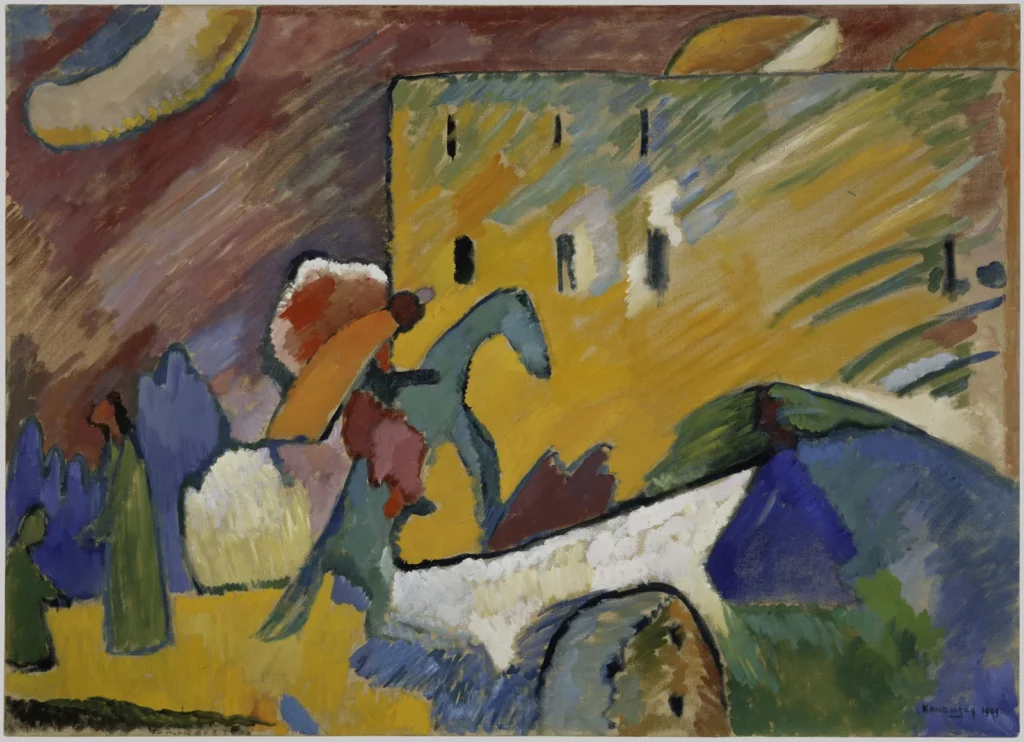
Vassily Kandinsky
Improvisation 3
1909
Huile sur toile, 94×130 cm
Donation Nina Kandinsky, 1976
Collection Centre Pompidou.
Domaine public. Photo © Centre Pompidou, MNAM-CCI/Hélène Mauri/Dist. GrandPalaisRmn
The next section explores his breakthrough period in Murnau and the founding of Der Blaue Reiter. Settling in the Bavarian Alps, Kandinsky’s natural style turned into broad brushstrokes and vibrant hues of color. A major highlight of this section – and one of the exhibition’s most significant achievements – is a dedicated focus on Gabriele Münter. Long overshadowed in art history as simply Kandinsky’s partner, Münter is presented here as an extraordinary, independent artist of German Expressionism. Exhibited in Italy for the first time, her work reveals a voice defined by simple forms, bold black outlines, and saturated colors because Münter painted what she felt, not what she saw.
The exhibition showcases their joint travel sketchbooks from Holland, Tunisia, and Rapallo, where both artists observed scenes side-by-side yet developed very different visual styles. A standout piece by Münter on display is Dragon Fight (1913), adapted from a small Russian folk sculpture kept in the Munich apartment she shared with Kandinsky. Through intense colors and heavy contours, Münter transformed the scene into a powerful symbol for the struggles faced by avant-garde artists. The section also details her legacy during the Nazi regime, when she secretly hid many Der Blaue Reiter masterpieces from being destroyed. Beside her works, visitors experience Kandinsky’s dialogue with composer Arnold Schönberg, illustrating how musical dissonance inspired his early abstract masterpieces like The Black Arch (1912) and Picture with a Red Spot (1914).
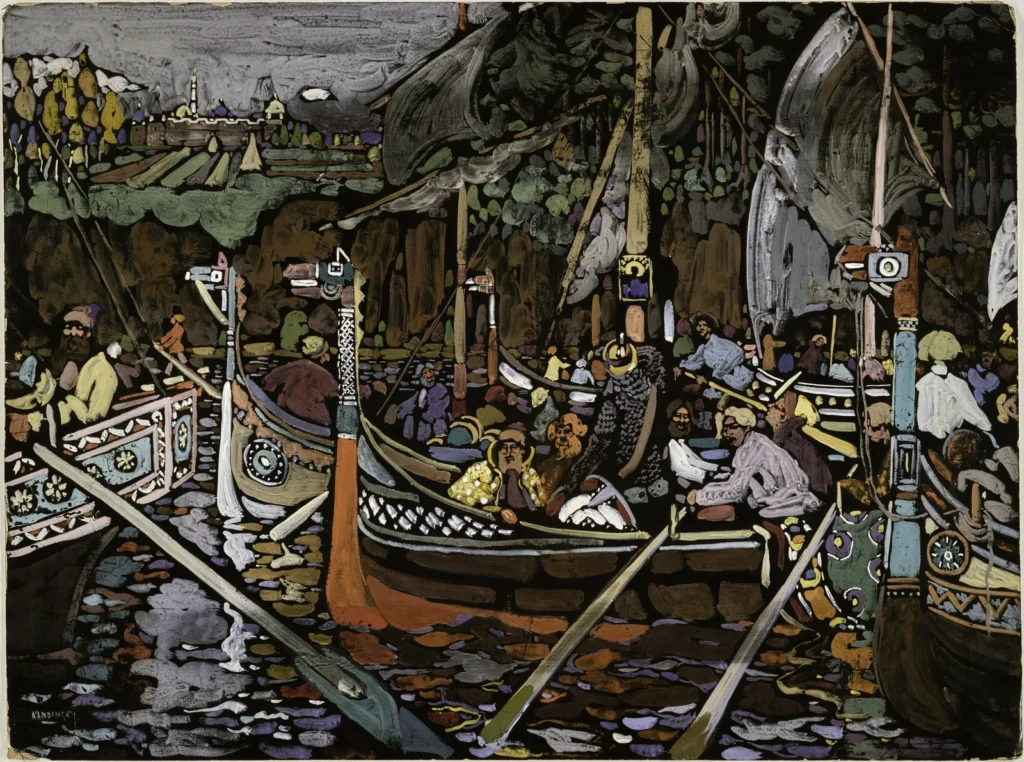
Vassily Kandinsky
Lied (Chanson)
1906
Tempera sur carton glacé, 49×66
cm
Legs de Nina Kandinsky, 1981
Collection Centre Pompidou.
Domaine public. Photo © Centre Pompidou, MNAM-CCI/Hélène Mauri/Dist. GrandPalaisRmn
Continuing on, the third section documents his return to Revolutionary Russia. Forced to flee Germany at the outbreak of World War I, his paintings were strictly limited to abstract graphic prints in 1915. Following his marriage to Nina Andreievskaia in 1917, he briefly returned to figurative work as seen in Nina and Tatiana on the Veranda (1917). Exposure to Suprematist and Constructivist artists pushed his art toward geometric styles and primary palettes, with In Grey (1919) as a prime example.
Concluding the first floor, the exhibition transitions into his years teaching at the Bauhaus in Weimar and Dessau (1922–1933). As the director of the mural painting workshop, Kandinsky embraced what he termed his “cold phase”. Hanging near the end of the first floor is the centerpiece of this era, Yellow-Red-Blue (1925), a composition in which shapes and primary colors are arranged according to an almost musical logic.
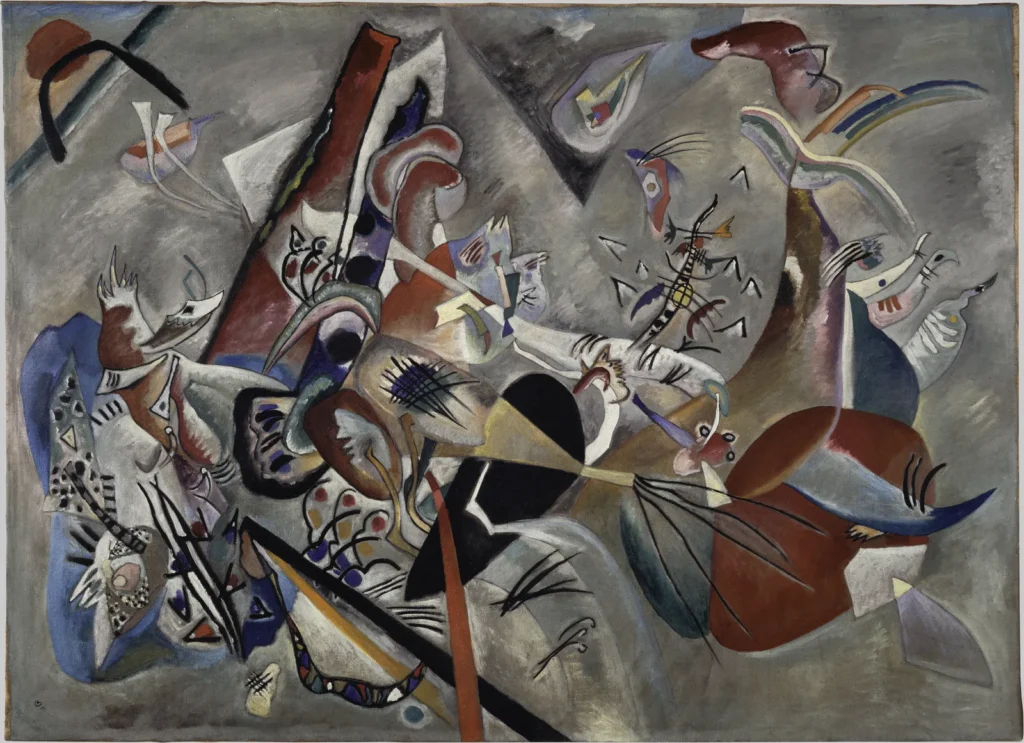
Vassily Kandinsky
Im Grau (Dans le gris)
1919
Huile sur toile, 129×176 cm
Legs de Nina Kandinsky, 1981
Collection Centre Pompidou.
Domaine public. Photo © Centre Pompidou, MNAM-CCI/Hélène Mauri/Dist. GrandPalaisRmn
Moving up to the second floor, visitors are able to explore the interactive stations and his late years in exile. The floor begins with an interactive wall dedicated to Bauhaus theory, where visitors can physically arrange primary-colored blocks (yellow, red, blue) into geometric shapes (triangle, square, circle) based on their personal perception. Just next to this wall is a listening display featuring a selection of the 95 preserved gramophone records from Vassily and Nina’s personal collection. Putting on the provided headphones lets visitors sample the couple’s musical taste, spanning Russian folk songs, Bach, Handel, Stravinsky, and 1920s foxtrots.
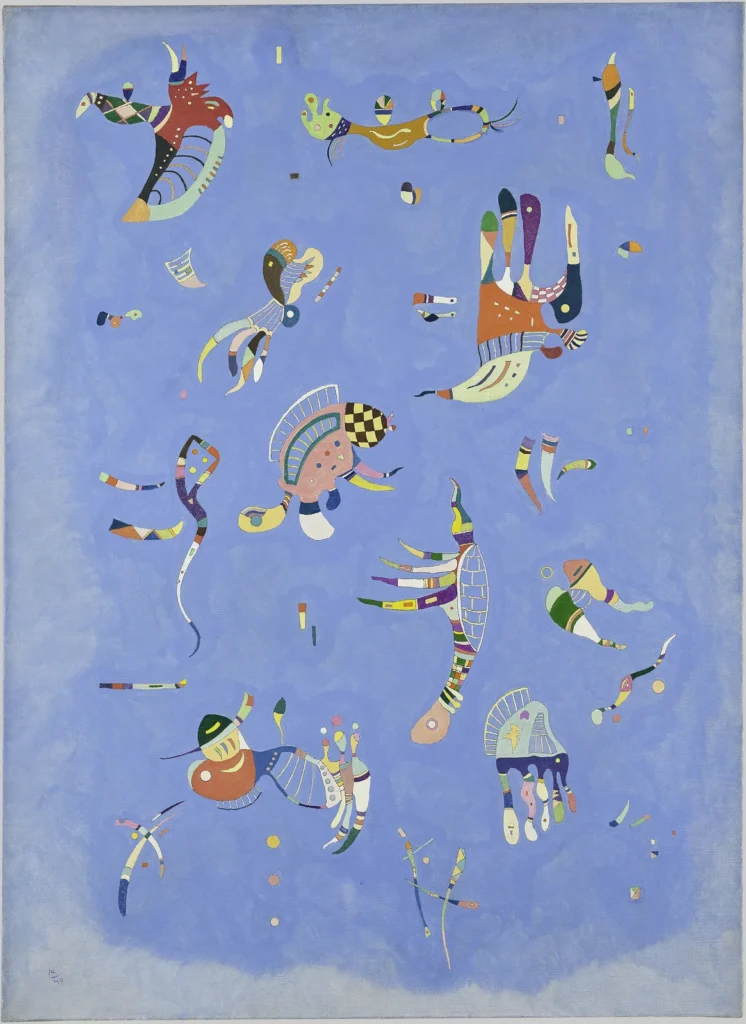
Vassily Kandinsky
Bleu de ciel
1940
Huile sur toile, 100×73 cm
Donation Nina Kandinsky, 1976
Collection Centre Pompidou.
Domaine public. Photo © Centre Pompidou, MNAM-CCI/Hélène Mauri/Dist. GrandPalaisRmn
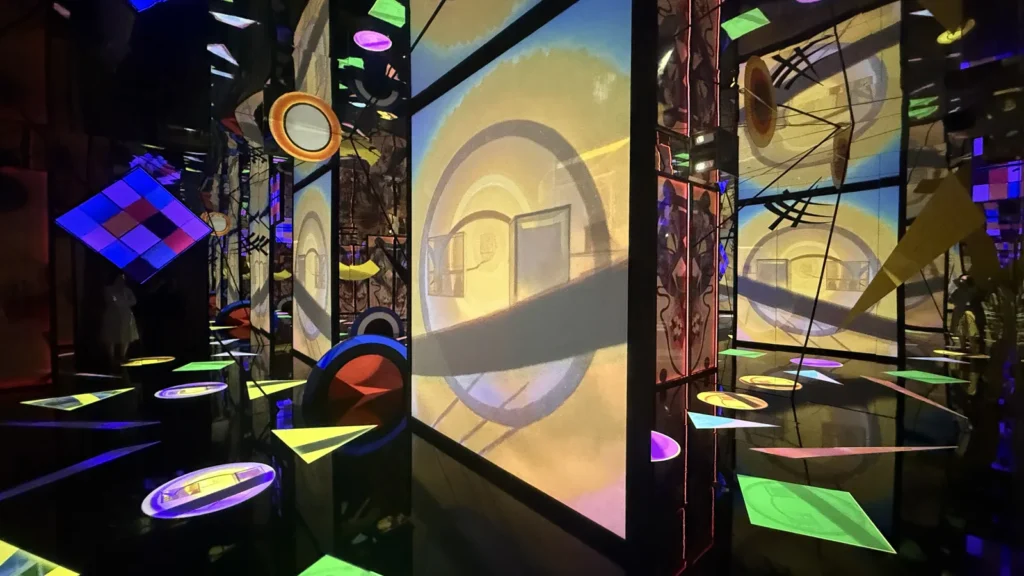
The final section covers his exile in Paris following the closure of the Bauhaus under Nazi pressure. Living in Neuilly-sur-Seine, Kandinsky’s style shifted from rigid geometry to biomorphic forms inspired by the microscopic world, showcased in late paintings like Composition IX (1936) and Sky Blue (1940). Near the end of the second-floor gallery is a floor-to-ceiling mirrored room projecting geometric shapes, lines, and colors that allow guests to step directly inside a living Kandinsky composition. The exhibition concludes as the path guides you into a gift shop filled with art prints, mini-books, candles, and souvenirs before leading back down to the first floor.
Plan to spend roughly 60 to 90 minutes exploring the galleries, audio stations, and interactive sections. Running through February 14, 2027, this immersive experience is a must-see on Rome’s cultural calendar.
BUY TICKETS
DISCOVER THE BEST CURRENT EXHIBITIONS IN ROME
The post
Kandinsky at Palazzo Bonaparte: Rome’s Big Autumn Exhibition
appeared first on Romeing
.