
Monday 2 November 2026 05:11
Artisan Spotlight: Bruno Amadi, Venice’s Glass Produce Master
Bruno Amadi does not make glass fruit in the decorative sense. His radicchio leaves, pea pods, and asparagus spears are not generic ornaments vaguely resembling something found in the produce aisle. They have weight, irregularity, transparency, and color. They look as though they ripened before being transformed into glass, which is more or less the point. […]
The post
Artisan Spotlight: Bruno Amadi, Venice’s Glass Produce Master
appeared first on Katie Parla
.
#culture #travel #venice
read the news on Katie Parla
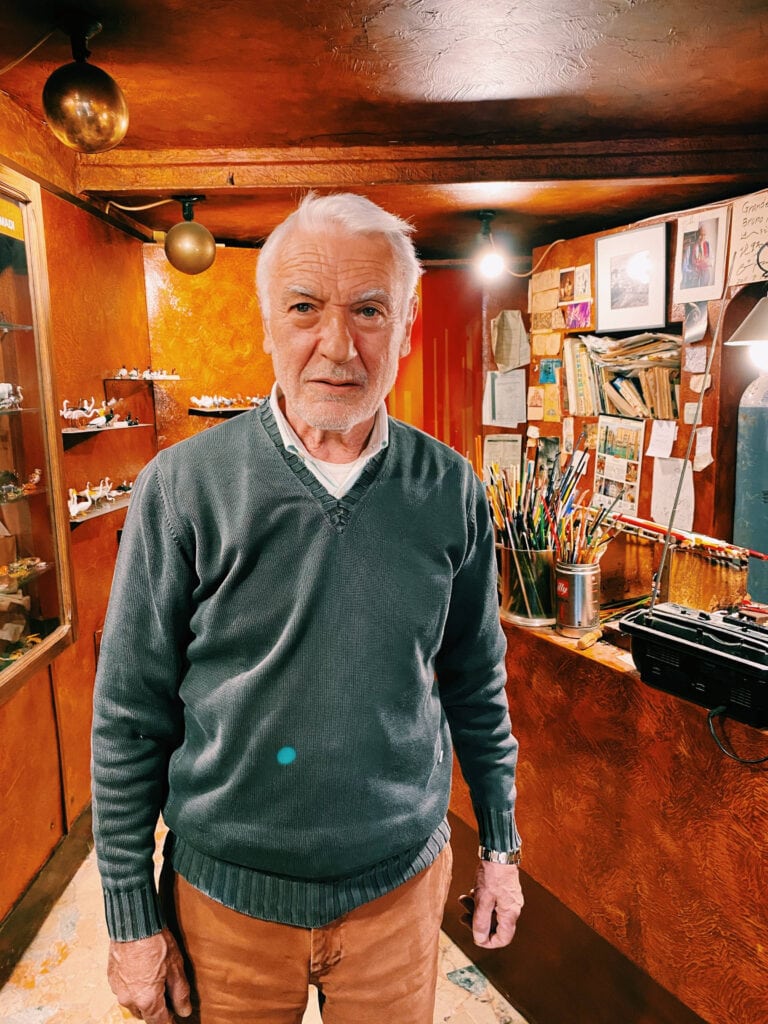
Bruno Amadi does not make glass fruit in the decorative sense. His radicchio leaves, pea pods, and asparagus spears are not generic ornaments vaguely resembling something found in the produce aisle. They have weight, irregularity, transparency, and color. They look as though they ripened before being transformed into glass, which is more or less the point.
Born on Burano in 1946, Amadi moved to Murano with his family when he was four. His father worked in a furnace, and Bruno began doing the same at 11, as many Murano boys did at the time. He went on to work for Salviati, Mazzega, and Barbini, big names in Venetian glassblowing. At night, he learned lampworking from his father, who returned to the flame after a full day in the furnace.
Amadi was one of six children, but the only one who remained devoted to glass. In 1974, already married, he opened his workshop in Calle dei Saoneri in Venice. Fifty years later, the space retains its furnace-red Venetian stucco walls and black glass shelves. Together they form a cabinet of curiosities containing vegetables, fruit, flowers, fish, shellfish, birds, amphibians, insects, and other creatures rendered with almost unnerving accuracy.
His work begins with sustained observation. Amadi studies living specimens, photographs, and drawings, then mixes different rods of glass over the flame to obtain the color he needs. His aim is not to create an ideal object but rather to capture the variations that make the natural world convincing.
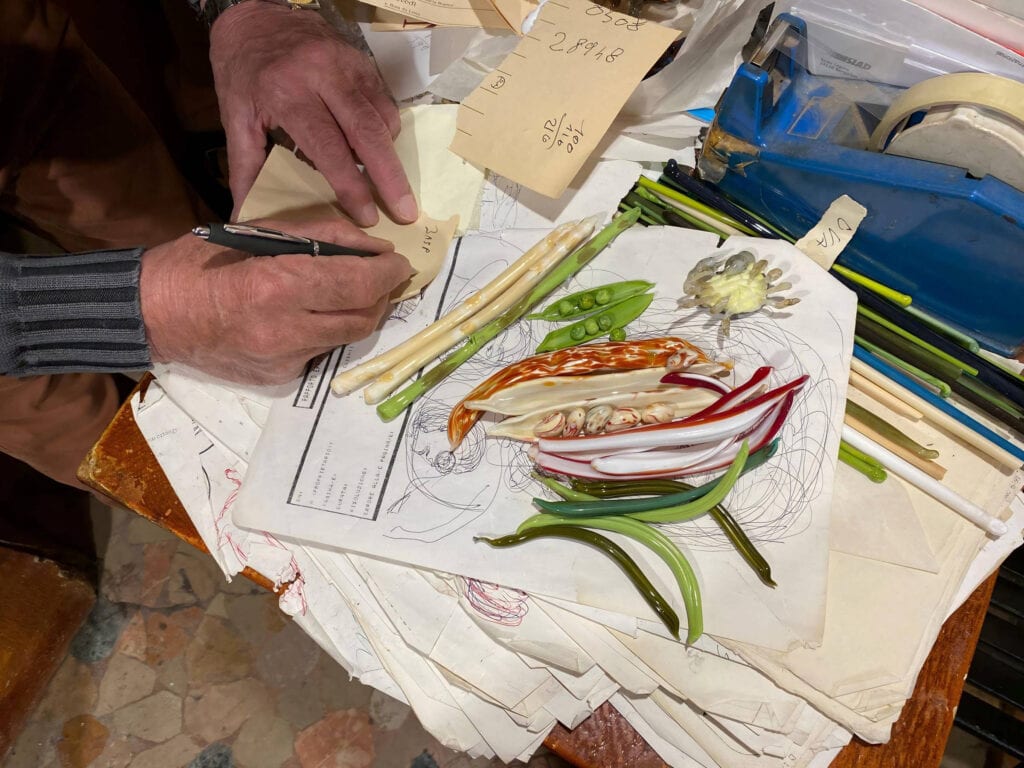
That distinction explains why his work feels alive. Nature is not neat or standardized, while contemporary glass rods increasingly are. Amadi remembers when every Murano furnace produced its own colors and shades from glass that was pulled by hand. Today’s machine-produced rods are more uniform. Amadi compensates through experience, mixing colors himself until they behave as he wants them to.
He rarely works in series. Curiosity determines what comes next, and collectors have spent decades feeding it by sending him botanical and zoological books, photographs, and articles. Today, he often works behind a closed iron gate to concentrate and escape the tourist traffic outside. Stand in front of his shop long enough and he’ll come to the door. Probably. Let him know “Ketty” sent you, and he’ll let you in.
His workshop has no obvious successor, which makes every fruit, fish, and flower more than a glass object. Each one records a lifetime spent looking closely at the natural world, then returning to the flame to get it right. Each is Bruno’s fragile legacy.
The post
Artisan Spotlight: Bruno Amadi, Venice’s Glass Produce Master
appeared first on Katie Parla
.