
Saturday 31 October 2026 22:10
Piazzas in Rome: A Walk Before the Crowds Arrive
Meta description A walk through the most famous piazzas in Rome, from Piazza di Spagna to St Peter's Square, timed to see each one before the crowds. Route, times and tips.
The post
Piazzas in Rome: A Walk Before the Crowds Arrive
appeared first on Romeing
.
#features
read the news on Romeing
Everyone who lives here knows the trick, and almost no visitor uses it. The famous piazzas in Rome belong to the city for about two hours every morning. The bars pull up their shutters, the street-cleaning trucks wash the cobbles, a nun crosses Piazza Navona with a shopping bag, and the Trevi Fountain is just a fountain again, loud and white and nearly empty. By ten o’clock it is over.
This is a walk through six of those squares and one bridge, in an order that lets you reach each at its quietest. It is about 3.5 km, under an hour of walking without stops, and closer to three hours if you stop for coffee, which you should.
Two reasons. The first is obvious: from mid-morning until evening the big squares are full, and you see more selfie sticks than travertine. The second is the light. In the first hour after sunrise it comes in low and soft, and the ochre and orange façades glow instead of glaring.
When is “early”? Sunrise in Rome is around 5:34 in mid-June, 6:31 in mid-April, 7:21 in mid-October and 7:30 in mid-December. Aim to be at the first stop within an hour of it. Plenty of bars in the centre are open by 7, so breakfast can come on the way.
Start at the Spagna stop on Metro line A, or walk in down Via del Babuino from Piazza del Popolo. At the bottom of the square is the Barcaccia, the fountain shaped like a half-sunken boat, made between 1627 and 1629 by Pietro Bernini, probably with his son Gian Lorenzo. Above it rise the 135 steps to Trinità dei Monti.
Before about 9am you can see the whole staircase with almost no one on it. Walk up to the top for the view back down Via Condotti, but don’t sit: since 2019 sitting, eating and drinking on the steps have been banned, with fines from €250. The house to the right of the steps, as you face them, is where John Keats died in 1821.
From Piazza di Spagna it is about ten minutes south through the side streets around Via Due Macelli. Listen for the fountain before you see it; Piazza di Trevi is so small that the water fills the whole square with noise.
Nicola Salvi’s fountain was finished in 1762, and it is the one place on this walk where timing matters in euros as well as elbow room. Since February 2026 the area down by the water costs €2 between 9am and 10pm, starting at 11:30am on Mondays and Fridays, when the fountain is cleaned. Before that it is free. Looking at it from the piazza above is always free. Whatever the hour, don’t sit on the edge or put your hands in the water: fines run from €40 to €240.
This is why the photographers behind
photographer-rome.com
start most of their couple sessions here, just after 7am. On a May morning at 7:13 they had the basin almost to themselves; two hours later there were rows of people in front of it.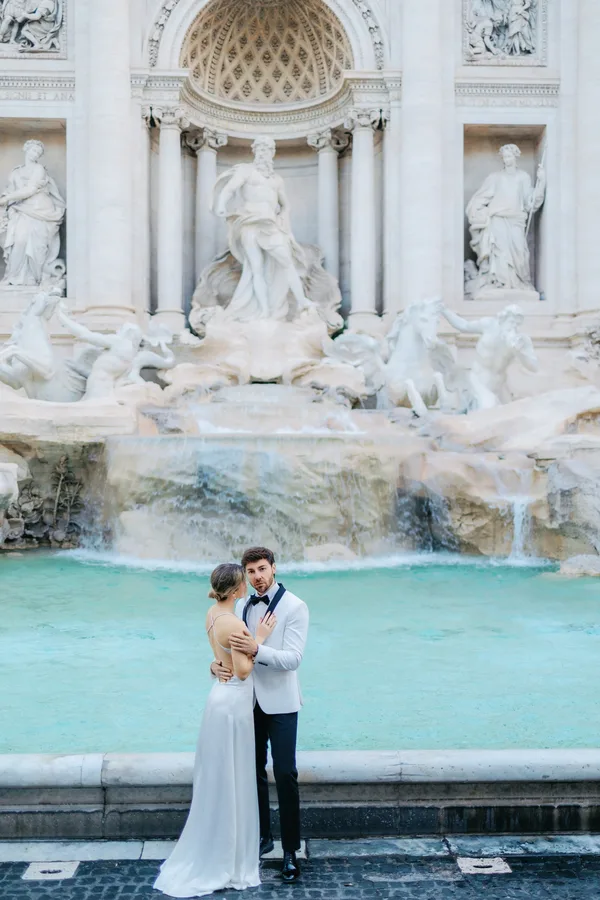
Photo:
Photographer in Rome
Head west along Via delle Muratte and Via di Pietra. Take the small detour into Piazza di Pietra, where the columns of the Temple of Hadrian are built into the front of a later palazzo. It is one of Romeing’s
three under-the-radar piazzas in Rome
, and at this hour you may have it entirely to yourself.A few minutes later you come out in front of the Pantheon. Piazza della Rotonda is best before the café tables go out; the fountain in the middle, with its Egyptian obelisk, lines up neatly with the portico and Agrippa’s inscription. The Pantheon opens at 9am, and it has cost €7 to go in since July 2026. If you are early, it is worth waiting for the doors: the disc of light from the oculus is at its sharpest in the morning.
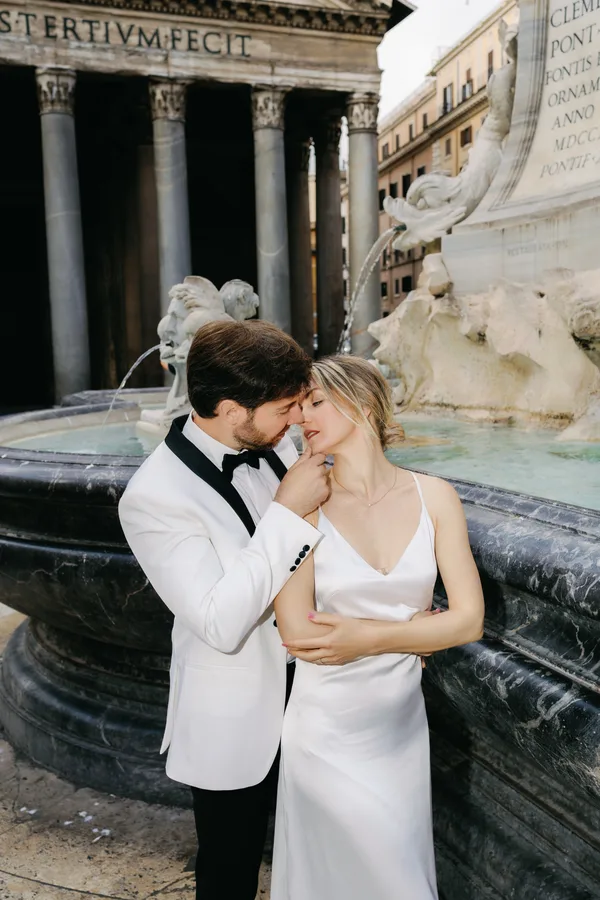
Photo: Photographer in Rome
Before you leave, walk round the left side of the Pantheon into Piazza della Minerva. The little marble elephant carrying an obelisk, designed by Bernini and unveiled in 1667, stands in front of Santa Maria sopra Minerva. Romans call it the Pulcino della Minerva.
Five minutes west and you walk into the long oval of Piazza Navona through one of its side passages. The shape gives it away: the square sits on the stadium of the emperor Domitian, and the houses follow the line of the old seating. Romeing has told the story of what lies under it in
The Hidden History of Rome’s Piazzas
.Early on, the painters and caricaturists have not set up yet, and you can see the whole square at once: Bernini’s Fountain of the Four Rivers in the middle, finished in 1651, and Borromini’s church of Sant’Agnese in Agone behind it. This is one of the few moments when you can actually stand back far enough to take in Borromini’s façade.
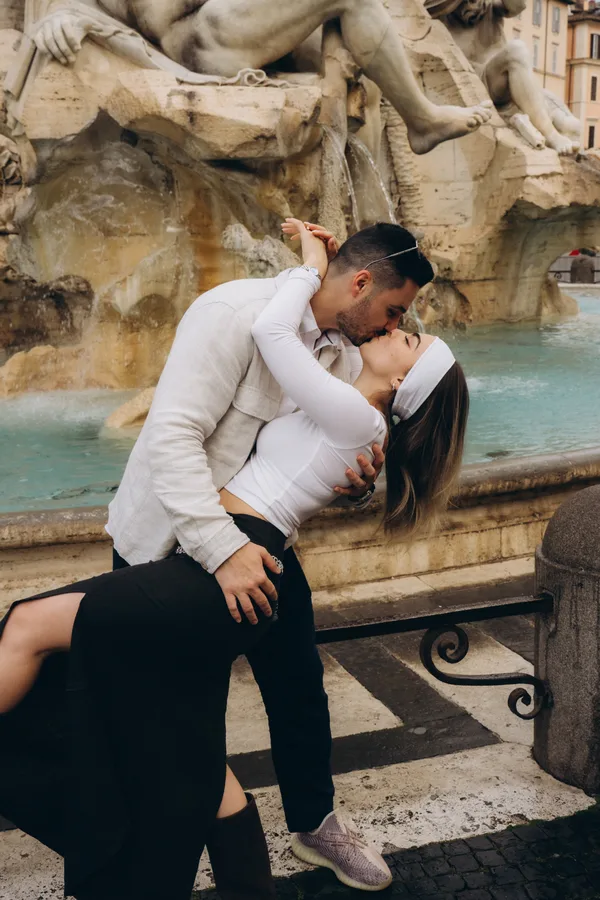
Photo: Photographer in Rome
Leave Navona from its north-west corner and pick up Via dei Coronari, the old street of antique dealers, towards the river. About ten minutes later you reach Ponte Sant’Angelo, the bridge Hadrian built to his mausoleum, which became Castel Sant’Angelo. The ten angels along the parapets were designed by Bernini and carved mostly by his workshop; the two he carved himself were judged too beautiful for the weather and moved to the church of Sant’Andrea delle Fratte, so the ones you see are copies.
In the first hours of the day there is hardly anyone on the bridge. Later the hawkers lay out their sheets and the crossing becomes a slow shuffle. The team at Photographer in Rome photographs proposals here for exactly that reason: an empty bridge, the castle behind, and the river below.
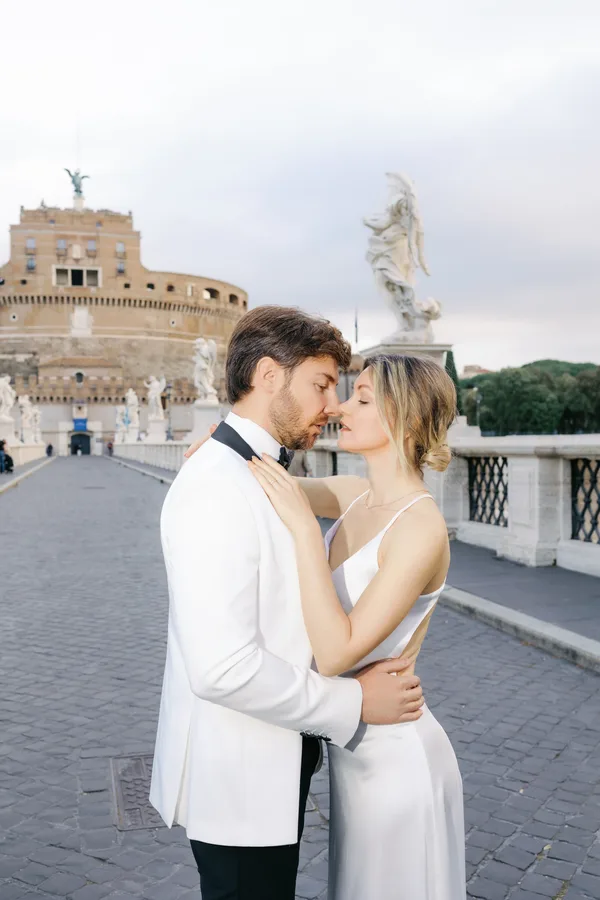
Photo: Photographer in Rome
Cross the bridge and walk left past the castle to Piazza Pia, where Via della Conciliazione begins. St Peter’s Basilica sits at the end of it, and in ten or fifteen minutes you are inside the arms of Bernini’s colonnade. Early in the morning the square is wide open, the queue for the basilica has not formed, and you can walk right across the middle. Remember that St Peter’s Square is in Vatican City, so check the papal calendar before you go: on audience days and big feasts the square is closed off for chairs and security.
Piazza del Campidoglio. Michelangelo’s square on the Capitoline Hill is a short walk from Piazza Venezia and works just as well early, especially if you continue to the terrace above the Roman Forum.
Campo de’ Fiori. The market sets up in the morning from Monday to Saturday, so here, unusually, a little later is better.
The small squares. Once the famous piazzas fill, that is the moment to switch to the quieter ones: Piazza Mattei with its turtle fountain, or Piazza della Madonna dei Monti.
- Shoes. Sampietrini, the black cobbles, are hard work in thin soles, and they are slippery after the trucks have washed them.
- Coffee as you go. Drink it standing at the bar, the Roman way. It is cheaper than sitting down, especially on the big piazzas.
- Sundays are kind. With fewer delivery vans and no market traffic, Sunday mornings are the quietest of the week.
- Do it backwards in summer. From June to August, consider doing the walk in reverse in the last hour before sunset, then finish at Trevi after 10pm, when the area by the water is free again and the fountain is lit.
However you do it, try to catch at least one of these squares while the city is still waking up. It is the Rome that people who live here see on their way to work.
The post
Piazzas in Rome: A Walk Before the Crowds Arrive
appeared first on Romeing
.