
Wednesday 11 November 2026 17:11
Fayum Portraits at Rome’s Ara Pacis: Faces from Ancient Egypt
Nearly 50 Fayum portraits from Roman Egypt at Rome’s Ara Pacis until May 2, 2027.
The post
Fayum Portraits at Rome’s Ara Pacis: Faces from Ancient Egypt
appeared first on Romeing
.
#events in rome #rome exhibitions
read the news on Romeing
Some of the faces in Rome this season are nearly 2,000 years old. At the Museo dell’Ara Pacis, large eyes, carefully styled hair, and delicate jewelry give the impression of meeting people rather than old figures from history. These are the Fayum portraits, once placed over the faces of mummified people in Roman Egypt.
On view from November 5, 2026 to May 2, 2027, Il potere del ritratto. Egitto e Roma. I volti del Fayum (The Power of Portraiture. Egypt and Rome. The Faces of the Fayum) brings together more than 110 works, including painted panels, funerary masks, marble sculptures, plaster casts, jewelry and linen shrouds. Curated by Claudio Parisi Presicce and Laura Petacco, the exhibition includes nearly 50 Fayum portraits.
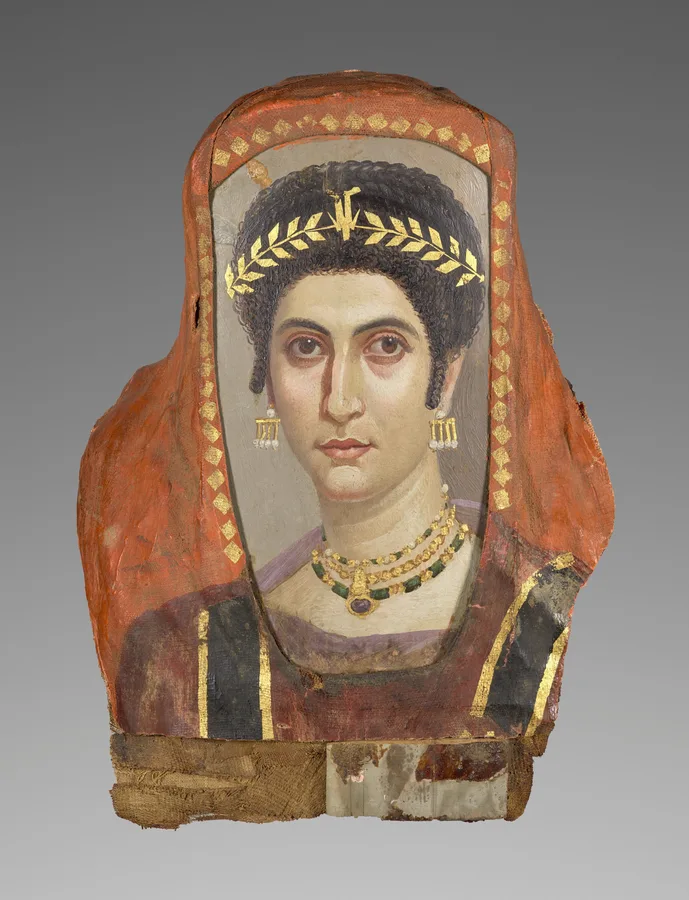
Ritratto funerario di una donna
100 d.C.
Encausto su legno di tiglio; doratura; lino
Getty Museum in Los Angeles
The portraits are from Egypt under Roman rule, where Egyptian traditions, Greek culture and Roman artistic styles existed side by side. In Rome, portraiture had long preserved the memory of ancestors and communicated social position. In Roman Egypt, that interest in personal appearance took a new form: a painted face incorporated into an Egyptian burial ritual.
The setting at the Ara Pacis is especially appropriate. The altar was commissioned by Augustus, whose conquest of Egypt linked the two worlds. The exhibition opens by placing a Ptolemaic funerary mask from the Museo Barracco opposite Roman marble portraits from the Capitoline Museums and the Centrale Montemartini. Between them, the first Fayum paintings introduce a different kind of image shaped by both traditions.
The first galleries explore why people wanted their likenesses preserved. Rare plaster casts from the tomb of the Valerii beneath St. Peter’s Basilica show how a face could be recorded after death and used to create a commemorative portrait.
The next section explores Roman Egyptian funerary customs. One object is the sarcophagus containing the mummy of a young girl named Giupra, on loan from Florence’s National Archaeological Museum. The portraits were not simply paintings made to be admired, but belonged to real people and formed part of how families remembered their dead.
Many Fayum portraits were painted on thin wooden panels and fitted among a mummy’s linen wrappings, directly over the face. Fewer than a thousand survive worldwide, making the group assembled in Rome a rare opportunity to see so many together.
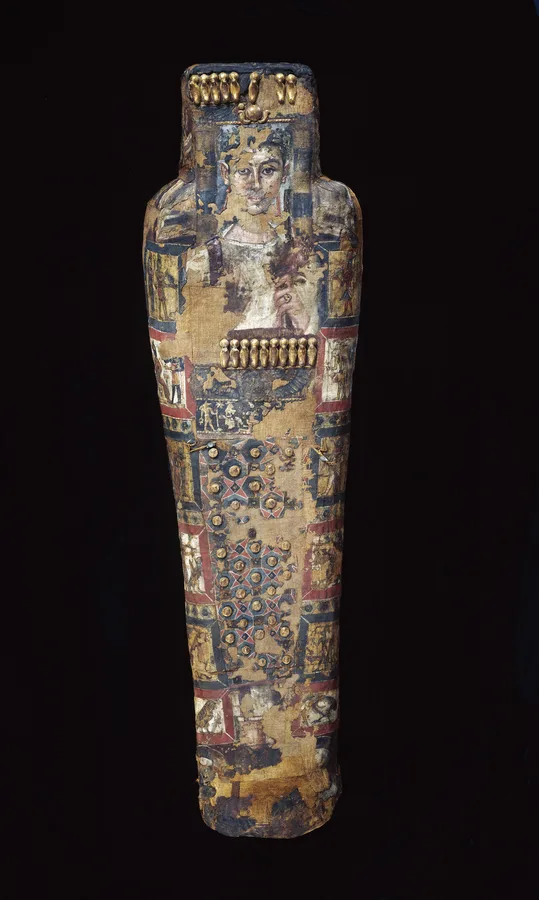
Mummia maschile
225 – 249 d.C.
Pittura a encausto su legno
Musée du Louvre in France
The central gallery is devoted to the painted faces themselves. There is Demos and her daughter, a mother and child found in the same tomb, and a soldier whose portrait belongs to Eton College. Others are known through little more than their features, hairstyles or jewelry. Displayed alongside Roman sculptures, the paintings show how differently a person could be remembered in stone and in color. Where marble captures a face through form and shadow, these panels use paint to create an impression of warmth and presence.
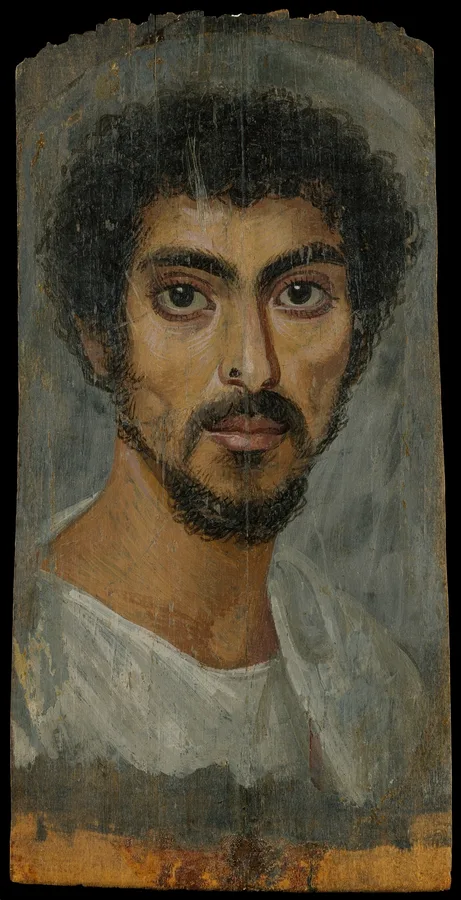
Ritratto di un uomo con un neo sul naso
130–150 d.C.
Encausto su legno
Metropolitan Museum of Art in New York
A highlight is the Two Brothers Tondo, a circular painted portrait from Antinoopolis featuring two young men. On loan from Egypt, it was restored there by Italian conservators specifically for this exhibition. It belongs to an exceptional group of works from Egyptian collections that had never previously traveled abroad.
The Louvre has lent 23 objects, including rare painted linen shrouds from Antinoe. Other portraits include Isidora from the Getty Museum and Eirene from Stuttgart’s Landesmuseum Württemberg. Eirene’s name is written on her portrait alongside a prayer to Osiris, offering a personal glimpse into the beliefs of those who mourned her. The Metropolitan Museum of Art has also lent portraits, and the exhibition includes a young man’s face recently found by the University of Salento’s archaeological mission in Egypt, shown to the public for the first time.
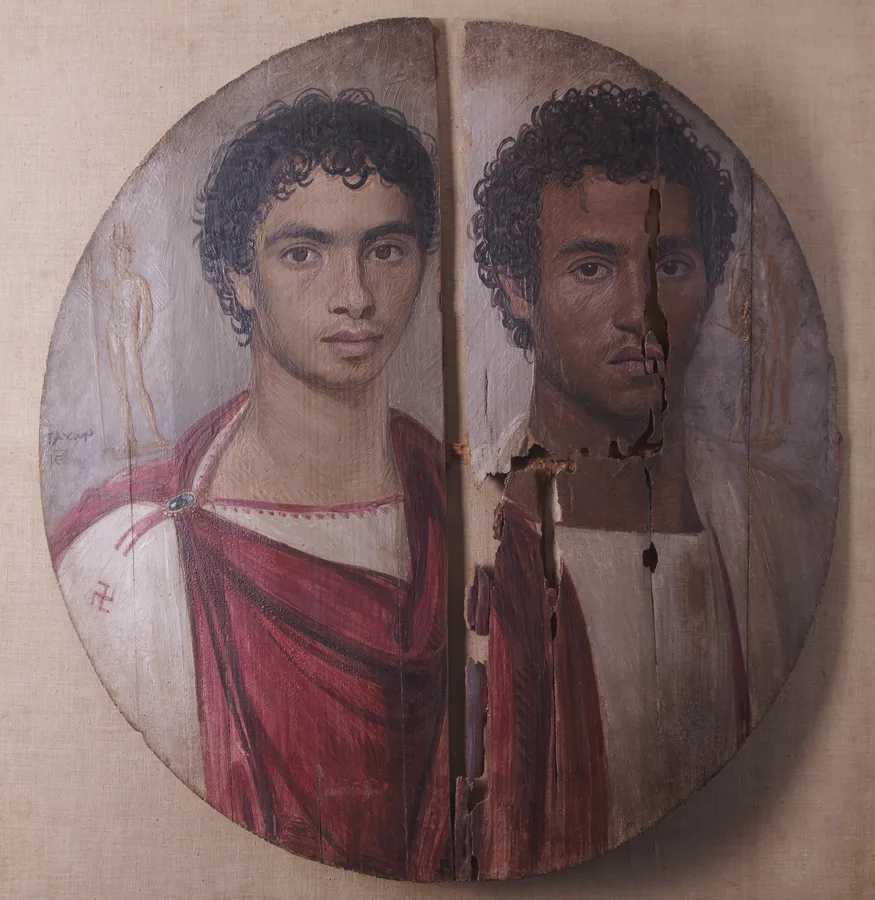
Tondo ligneo dei Due Fratelli (“Tondo di Antinoopolis”)
Legno, pittura a encausto
Egyptian Museum in Cairo
A later section explores the materials behind these images. Artists worked on wooden boards only a few millimeters thick, using tempera or encaustic, a technique involving pigments and heated wax. Panel edges were sometimes cut to fit into mummy wrappings, while other faces appeared on linen or were modeled in stucco.
Jewelry from Pompeii and Herculaneum provides another comparison. Earrings and necklaces resembling those in the paintings show how closely these faces were connected to fashions across the Roman world. The exhibition ends with third-century painted panels and large funerary shrouds from Antinoe. Although the tradition of wooden portraits gradually disappeared, the desire to preserve a recognizable face continued in other forms.
Almost two millennia later, what stays with you is not only the rarity of the works but the people looking out from them. Their portraits show us that the wish to be seen and remembered has changed very little.
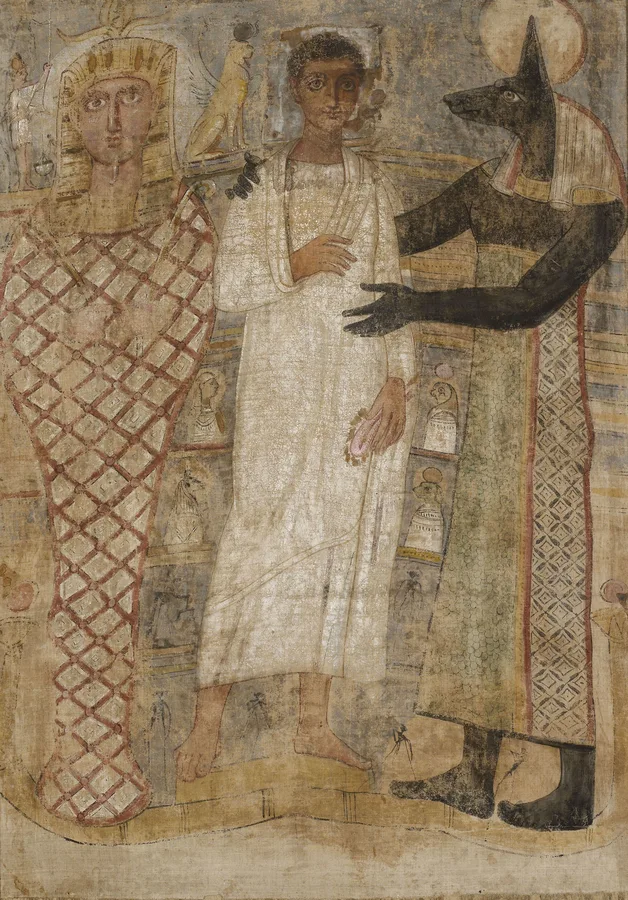
Sudario dipinto
50-150 d.C
Pittura su lino
Musée du Louvre in France
The Fayum Portraits are on display at the Museo dell’Ara Pacis, located at Via di Ripetta 180, from November 5, 2026, to May 2, 2027. The museum is open daily from 9:30am to 7:30pm, with last admission at 6:30pm. It is closed on December 25 and May 1, with reduced opening hours on December 24 and 31.
Tickets cost €17 for standard admission and €15 for reduced admission, covering the exhibition only. A combined ticket including the Ara Pacis Museum costs €25 (€19 reduced) for non-residents, while family tickets cost €22 for two adults with children under 18 and €11 for one adult with children.
Click here to buy tickets
.DISCOVER THE BEST CURRENT EXHIBITIONS IN ROME
The post
Fayum Portraits at Rome’s Ara Pacis: Faces from Ancient Egypt
appeared first on Romeing
.