
Tuesday 17 November 2026 08:11
Sant’ Ivo alla Sapienza: Borromini’s jewel is open again!
Every so often, a guest staying in our apartments around Piazza Navona asks us about “that church with the spiral on top of the dome”. For years, they could see it from afar, but our answer was a slightly embarrassed one: you could go inside only at certain times on Sunday morning, during Mass, if […]
#navona area #churches in rome #francesco borromini #free events #free tours #sant'ivo alla sapienza #st. ivo alla sapienza
read the news on FromHometoRome – FHTR – Making You Feel Right at Home
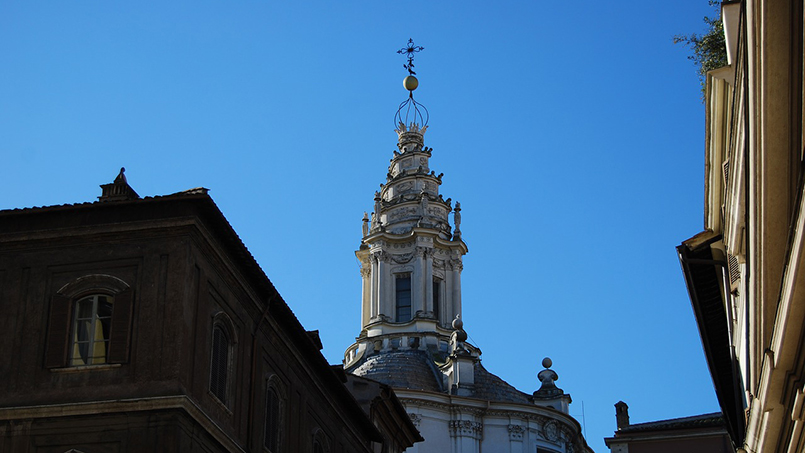
Every so often, a guest staying in our apartments around Piazza Navona asks us about “that church with the spiral on top of the dome”. For years, they could see it from afar, but our answer was a slightly embarrassed one: you could go inside only at certain times on Sunday morning, during Mass, if the doors happened to be open. Today we get to give a much better answer, because one of the great masterpieces of Roman architecture is finally open to visitors again.
The church reopened at the end of October 2026, thanks to a collaboration between the State Archives (the church’s next door neighbors!), the Diocese of Rome, and the Touring Club Italiano. It is open Monday to Friday, from 9:30am to 1:30pm, and admission is free. Visits are accompanied by Touring Club Italiano volunteers. The address is Corso del Rinascimento 40, a few minutes’ walk from Piazza Navona.
If you read our earlier post on Francesco
Borromini’s masterpieces in Rome
, you’ll remember that Sant’Ivo came with a big asterisk. That asterisk is now much smaller.Short answer: it is one of the most original buildings of the Roman Baroque. Small in size but immense in architectural quality, it is considered a reference point for generations of architects.
The longer answer starts with its origins. Sant’Ivo began as the chapel of Rome’s main university, the Sapienza, which was founded in 1303 by Pope Boniface VIII. Borromini was named architect of the Sapienza in 1632 by Pope Urban VIII, and worked on the church from 1642 to 1660, adapting his ideas to the structures that already existed.
What he built is unlike anything else in the city. The star-shaped plan is an architectural puzzle that still fascinates scholars and visitors. From that geometry come walls that alternate concave and convex curves, giving the space a sense of continuous movement. The spiral lantern rises above the city’s rooftops, so you may have spotted it long before you knew what it was.
The recent restoration adds another reason to go now. It brought back the many shades of white that Borromini designed to give the building its dynamism. The interior is about light and subtle tonal contrast rather than color, which is a very different experience from the gilded excess of many Roman churches. The altarpiece is by Pietro da Cortona. It was left unfinished at his death in 1669 and completed by his pupils.
Whereas other famous churches in Rome adorn piazzas or picturesque streets, part of the charm of St. Ivo alla Sapienza is how you reach it. The church is tucked inside the courtyard of the old university complex on Corso Rinascimento. You walk through the courtyard, and the church’s curved front appears at the far end like a stage set.
- Plan for weekday mornings. There are no weekend or afternoon openings planned as we write this, so it won’t fit a Saturday stroll. It slots in well between breakfast and lunch.
- Expect volunteer-led visits. Entry is free, but the volunteers set the pace, so a little patience is part of the deal.
-
Dress as you would for any church. It is still a place of worship (read this old post about an appropriate dress code here!)
- Check for concerts. From December, the church will host a series of classical and sacred music concerts, including one for the Christmas season. Hearing music in this space will be remarkable.
Sant’Ivo sits in one of the richest corners of the historic center. Sant’Agnese in Agone, another Borromini church, is a few minutes away on Piazza Navona. Pasquino, the most famous of
Rome’s talking statues
, is close by too. The Pantheon is a short walk in the other direction. And there’s a few Caravaggio
you can see for free just a stone’s throw from here, just like some
of our managed
apartments
!Our apartments are a short walk from Corso Rinascimento, which means our team often ends up pointing guests toward the lesser-known attractions of this neighborhood, the ones that never make it into a standard itinerary. If you’d like to be based right in the middle of all this,
browse our apartments
and get in touch.Last updated: November 2026